Thursday, March 29, 2012

The Immortal

“They have served the dark will of Persian kings for five hundred years.  Eyes as dark as night... teeth filed to fangs... soulless.  The personal guard to King Xerxes himself: the Persian warrior elite.  The deadliest fighting force in all of Asia... the Immortals.”

-         David Wenham (Dilios in 300)


            Well, not quite, actually the name Immortals…
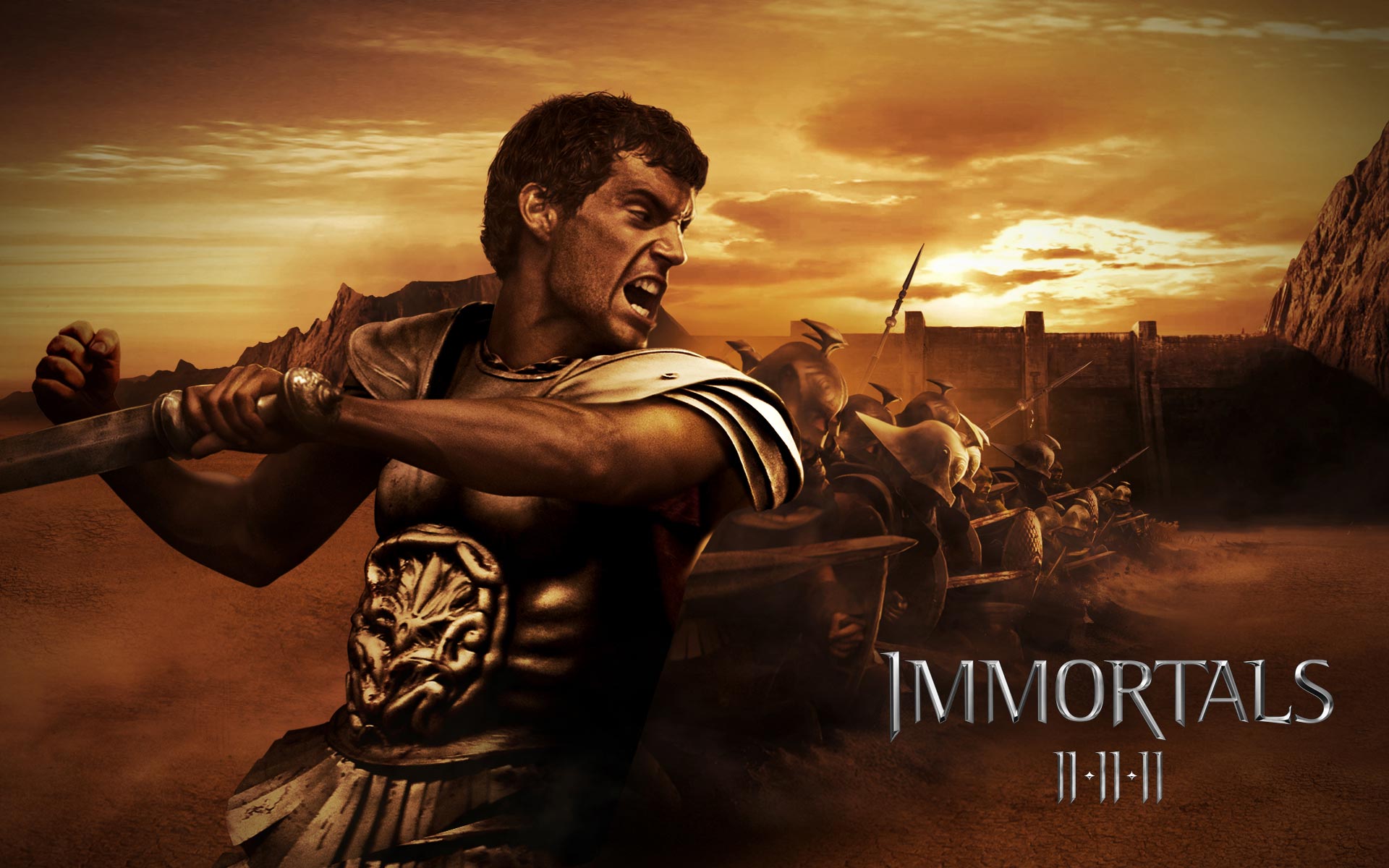

            No, not this either, the name Immortals comes from a mistranslation of the word Anûšiya ('companions') with Anauša ('Immortals') by the Greek historian Herodotus.  The "Immortals", "Ten Thousand Immortals", or "Persian Immortals" were said to be an elite force of soldiers who fought for the Achaemenid Empire.  This force performed the dual roles of both Imperial Guard and standing army during the Persian Empire's expansion and during the Greco-Persian Wars.

The Immortals were described as being heavy infantry led by Hydarnes that were kept constantly at a contingent of exactly 10,000 men.  Herodotus claimed that the unit's name stemmed from the custom that every killed, seriously wounded or sick member was immediately replaced with a new one, maintaining the cohesion of the unit.  This procedure, coupled with the mystery of an unknown culture could have given rise to the belief that the Immortals were truly incapable of being killed.


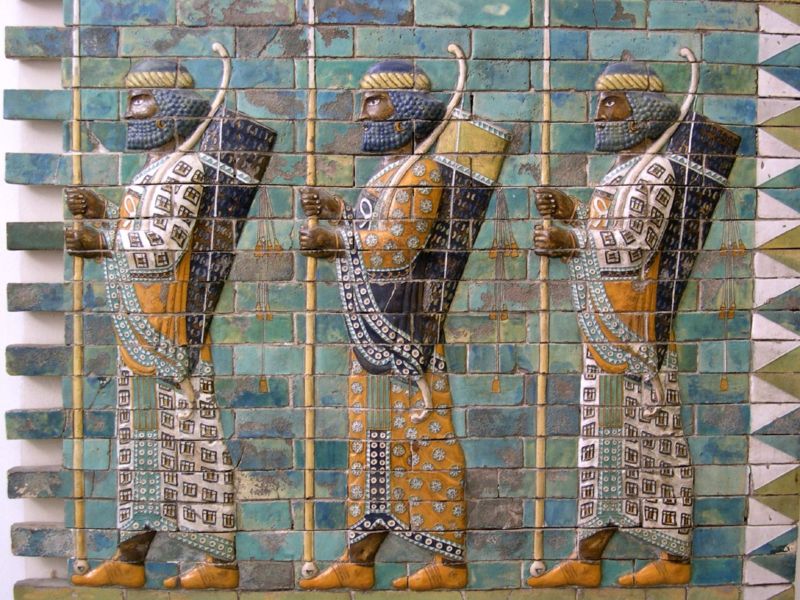
Aha, now that is more like it!  Herodotus describes the Immortals being armed with wicker shields, short spears, swords (or large daggers), with bow and arrows.  This would seem to indicate that the Immortals were expected to be able to adapt to various military situations, such as long-range against cavalry, medium range against spear-wielding infantry, and short range against swordsmen.  Their shields could also protect them from enemy arrows.


Unfortunately, wicker shields offer little to no protection against weapons of iron or bronze, which caused more than a few problems at the Battle of Thermopylae.

Underneath their robes they wore scale armor coats. The spear counterbalances of the common soldiers were of silver, and higher ranks used spears capped with golden ends.  A caravan of covered carriages, camels, and mules, followed the regiment and transported their supplies; concubines, attendants, and special food that was reserved only for their consumption.  This conjures forth the image of a truly decadent and prosperous army to the enemies of the Persians, and creates an immediate desire to enter the ranks of the Immortals in the ranks of common soldiers.


The headdress worn by the Immortals is believed to have been the Persian tiara, but the actual form is uncertain, as some sources describe it as a cloth or felt cap.  A cloth hood could be pulled over the face to keep out dust in the arid Persian plains, which admittedly would be useful in that climate.  Surviving stone carvings represent the Immortals as wearing elaborate robes and gold jewelry, though these garments and accessories were most likely worn only for ceremonial occasions.

            From their armaments, their support, and their strict attention to cohesion, the Persian Immortals seem a force and display of wealth to demoralize enemies.  They were soldiers, but with the aid of superstition and vast numbers, the enemies of the Persians would need great courage to continue fighting a line of guards seemingly without end.

On a minor note, the previous post on the Viking Berserker was difficult to read because of a technical issue, which I do not understand.  When I previewed the page, the text was supposed to be white on a dark gray background.
  
References:

The above are promotional images for the 300 and Immortals motion pictures


Thursday, March 15, 2012

Viking Berserker

Cattle die
kinsmen die
all men are mortal.
Words of praise
will never perish
nor a noble name.

- The Havamal or Book of Viking Wisdom

This entry will focus on the weapons and armor of a warrior so fierce, all of Europe once called them Demons.  The Viking Berserkers, who are the origin of the term berserk, were to have fought in a nearly uncontrollable, trance-like fury.  Due to this seemingly inhuman rage, intimidating fighting style, and proclivity for sea raids, the Vikings have been romanticized the world over.


Some believe that berserkers worked themselves into a rage before battle, while others think that they might have consumed drugged foods.  I remember reading about a Norse maiden boiling moss to create a broth for warriors that would “Give them the strength of the bear”.  Whether or not this story was accurate, one of the distinguishing characteristics of the berserkers was their use of bearskins and skulls in their attire.


 So the first weapon I will submit as part of the Viking arsenal was fear.  Striking from the mists up and down the coasts of Europe and Scandinavia, wearing the faces of fierce creatures, and looting churches, made the Berserkers more than men in the minds of their adversaries, they were terrifying creatures from the depths of Hell.

The second weapon, if you will, was the longship, or “dragonship” as the English called them.  While not techncially a ship designed for naval combat, it was light, fast, and shallow enough to sail and beach just about anywhere, giving the Vikings the ability to explore and conquer.


The first physical instrument of Viking warfare was the reliable… the classic… Spear!  The spear consisted of a metal head which could measure between twenty and sixty centimetres, which was mounted on wooden shafts of two to three metres in length. The barbed throwing spears were often less decorated than the ostentatious thrusting spears, as the throwing spears were often lost in battle.  Most evidence indicates that spears were used with one hand, and that warriors would remove the head of the spear to prevent a foe from re-using the weapon.

The second standby of the Viking Berserker was the sword, which was a modification of the Roman spatha, evolving into what most of us would recognize as the classical knightly sword in the 11th century.  Blade length varied from 28 to 33 inches, and posessed a single wide fuller, and later on, multiple narrow fullers.  Fullers are the indentations down the length of the blade, and were used to increase the strength of the sword while reducing its weight, which would allow the wielder to swing faster with more powerful strokes.


The last of the Viking melee weapons mentioned here is the axe, the same tool used for chopping wood.  These axes could also be thrown or swung with head-splitting force, and depending on the design, could be wielded with one or both hands.  An axe head was mostly wrought iron, with a steel cutting edge. This made the weapon less expensive than a sword, and was a standard item produced by blacksmiths, making them highly accessible to most Vikings.  There is some debate as to whether or not the axe was more common than the spear, but this is difficult to tell because of the ease of training with the spear as a hunting implement and the availability of the axe for logging.

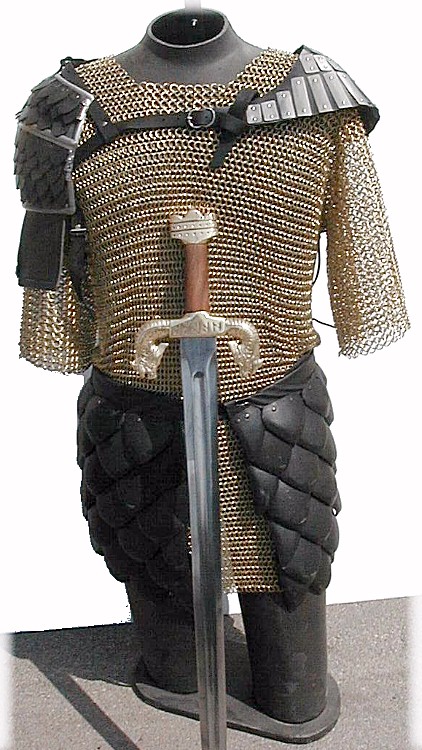
The chainmail shirt is interpreted as elbow-and-knee length, from the single specimen recovered from Ringerike in central Norway.  It was likely worn over thick clothing, and protects the wearer from being cut, but offers little protection from blunt trauma. Mail was very expensive in early medieval Europe, and would likely have been worn by men of status and wealth.  Expensive mail armour was also seen as cumbersome and uncomfortable in battle. Traditionally, Vikings have been thought to have opted for leather body armour, as it was both more flexible and cheaper. However, there is no archeological evidence to support this.

The shield was the most common means of defence, as it was cheaper to produce than full armor. The Viking epic sagas specifically mention linden wood for shield construction, although finds from graves show mostly other timbers, such as fir, alder and poplar. These timbers are not very dense making them light and easy to manuever.  They are also not inclined to split making them very durable and reliable for more than one battle.  Round shields seem to have varied in size from around 18 to 48 inches, but those ranging from 30 to 36 inches are the most common.


References:

http://en.wikipedia.org/wiki/Berserker
http://en.wikipedia.org/wiki/Viking_Age_arms_and_armor
http://genes.mit.edu/burgelab/vikingquotes.htm

Thursday, March 1, 2012

Egyptian Chariot Archer

By 3000 B.C. the art of Egypt was so ripe and so far advanced that it is surprising to find any student of early culture proposing that the crude contemporary art of the early Babylonians is the product of a civilization earlier than that of the Nile.

-James H. Breasted

This third blog will center on a warrior from the past, who is instantly recognizable the world over, even though their armaments and tactics were taken from the very cultures that beset Egypt in ancient times.

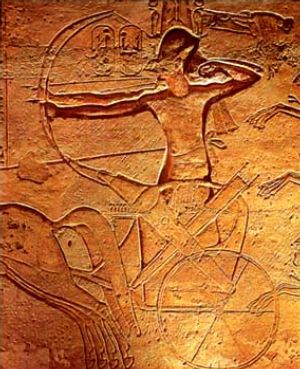
When one thinks of the ancient Egyptians, they immediately call to mind the Pyramids at Giza, the Sphinx, the temple of Ramses at Abu Simbel, and usually, this image…


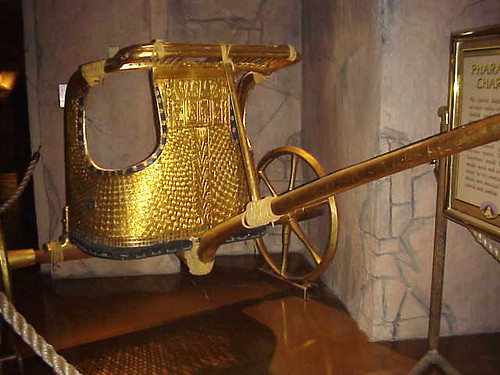
Which is interesting, because the Egyptians did not invent the chariot, they observed, defeated, and recreated it from their conflicts with the Hyksos invaders in the 16th century BC.  The chariot comes from 3000 BC in Mesopotamia, as an adaptation of the eariliest form of wheeled vehicle.  The four best specimens of Egyptian chariots are those recovered from the tomb of Tutankhamun.


Other cultures and civilizations made use of the chariot in ancient times, but due to the rocky terrain in Europe and Asia, it was used more as a vehicle of royalty or sport instead of warfare.  The fact that it was also an prone to structural failures probably further limited its military use outside of the fertile crescent.


We can infer that the ancient chariots were also somewhat unstable due to their single axel, and considering this, along with the vast number of images depicting chariot archers, that their tactical use was simple, but effective.  If a large enough number of chariots armed with archers were able to ride towards a target enemy formation of foot-soldiers or cavalry, the archers would simultaneously fire toward the enemy formation in an arching pattern, thereby increasing the likelyhood of an arrow stiking home.

If the archers were unable to halt the advance of opposing foot-soldiers, the horses could simply trample them, and if the opponents were riding horses, the charioteers would likely have been able to outrun enemy cavalry briefly, allowing the archer a closer shot.  The Battle of Kadesh has been theorized to have been the largest chariot battle in history, with some 5000 or 6000 chariots participating.


The Egyptian longbow, also known as the angular bow, was the primary reason behind the success of the chariot in Egypt.  After all, you cannot have an archer, without a bow.  The following is a video on the construction and power of the angular bow.


Egyptian arrows, which have been recovered in large numbers, and often in a very good condition, are very intriguing. They were usually about 0.35-0.5 ounces, between 30 and 33 inches long, and made of a slender reed giving a large deflection.  The ability of the arrows to make deep and lethal wounds is vouched for in several tests, and is believed since they remained the standard equipment of the Egyptian army for several centuries.  Although some suggest that since the arrows were so light, and the bows not quite as powerful as those found today, that the reason behind the chariot archers’ destructive force, was the skill of the archer in shot placement.  Considering the strain of the bow, the instability of the moving chariot, and the unpredictable movement of the enemy, I would consider the Egyptian chariot archer quite skillful indeed.

References


http://margo.student.utwente.nl/sagi/artikel/egyptian/egyptian.html

Thursday, February 16, 2012

The Samurai

Rectitude
Courage
Benevolence
Respect
Honesty
Honor
Loyalty

- Seven Virtues of Bushidō

Perhaps not quite of the ancient world, these figures have still inspired countless poems, plays, and are included in so many anime that it is mind-boggling.  For this second post, I chose to look at the weapons and armor of another legendary historical warrior… The Samurai.


One might ask why choose the Samurai over the Ninja for the purposes of this assignment, and the answer is the abundance of information on Samurai culture.  This means that I also won’t get caught up in the Pirates vs. Ninjas debacle.

Historically, the Samurai didn’t appear until roughly 646 AD, after the Taika reforms.  These reforms included land redistribution and heavy new taxes, to support an elaborate empire similar to that of China.  This prompted the creation of a new military class to defend Japan and aristocratic officials.

What we know of the Samurai today comes from historical accounts, legal text in Japanese, death poems written by Samurai, and journals from Europeans who traveled with the Samurai.  Considering that the Samurai were not only encouraged to be literate, but to also be well versed in Chinese classic texts, as well as military strategy, reconstructing their way of life is far easier than that of more ancient cultures.  These individuals could write about their life and times in a language that still exists today, and whose documents still exist today.

Archaeological sites in Japan pertaining to the Samurai seem to have a common theme; most of them were (and still are) castles.  A listing of which may be found here:

Considering that castles are at their essence, fortified locations, it is logical that the elite military of Japan, at the service of those who were lords of castles, would have records kept in such places.  And if a castle was well fortified enough to escape capture, those places would remain safe through time.

Samurai, like many warriors, possessed a multitude of martial disciplines, and trained to use a variety of weapons.  The first weapon listed here did not arrive until between 1185 and 1333 AD (otherwise known as the Kamakura Period), but it is the most recognized of the Samurai weapons, which evolved from the earlier tachi and uchigatana swords.  The katana was considered by many to be the epitome of the sword, the finest in the world, and was said to figuratively represent the soul of the Samurai who wielded it.


Interestingly enough, there is one place in Japan where these swords are still made today, by the same customs and standards of their historic counterparts.  The following is the first of a four part video series on the modern construction of ancient swords.

  
The other half of the daisho, or Samurai sword pair, was the wakizashi, reminiscient of the katana, only slightly shorter.  The wakizashi served the function of an indoor sword, since it was a sign of respect to leave the katana at the entryway of a nobles’ house but still carry the wakizashi inside.  The wakizashi was said to represent the honor of the Samurai who wielded it, and it was with this weapon that a Samurai would commit Seppuku, or ritual suicide.


The principal ranged weapon of the Samurai was the Yumi, an asymmetric composite bow made from bamboo, wood, rattan and leather. The yumi could also be fired from horseback because of its asymmetric shape. The practice of shooting from horseback became a Shinto ceremony known as yabusame, and is still a practiced sport today.


The Samurai commonly used Pole weapons including the Yari and Naginata during their early years before the rise of the Japanese sword, and up to the end of the Meiji era, when the Samurai were disbanded.  Their function was to out-reach their opponent, and they were far easier and quicker to produce, such that they were ideal for foot soldiers.


The first types of Japanese armors identified as samurai armor were known as Yoroi, and included a number of auxiliary forms of protection. These early samurai armors were made from small individual scales that were made from either iron or leather, and were bound together into small strips. The strips were coated with lacquer to protect them from water, and were then laced together with silk or leather and formed into complete chest armor.


The Samurai were a paradoxical union of soldier and philosopher, protector and tyrant, chivalrous and self-immolating.  Their weapons and armor were not merely tools, but they were intrinsically tied to their bearers, and passed down from generation to generation.  Even today Japanese households will keep shrines to their ancestors cradling their treasured swords.

References:


Wednesday, February 1, 2012

The Spartan (Greek Hoplite)


“Hence you will not say that Greeks fight like heroes but that heroes fight like Greeks”
-         Sir Winston Churchill

I thought I would begin the first blog assignment with a universally recognized warrior from history, The Spartan.  Spartans have become part of popular culture; they are used as mascots, such as the Michigan State University Spartans, and Master Chief from the HALO video game series.  Spartans are also used as source material for entertainment, such as having television shows and full length feature films dedicated to them.

Entertainment aside, it is true that the Spartans of Ancient Greece were feared combatants, and in this blog, we will be looking at their weapons and armor, from a historical, anthropological, and archaeological view.

According to archaeologists what we think of as “Ancient Greece”, started roughly around 3000 BC.  Small caves around the Acropolis rock and the Klepsythra spring show remnants of human use.
Later on, the Cycladic, Minoan, and Mycenaean civilizations emerged about the Aegean Sea and further inland.  These communities eventually developed into city-states, such as Athens, now capital of Greece, and Sparta.

These city-states, having different cultural backgrounds, religious views, and threat of invasion from Persia, (I think an article on the Persian Immortal will be a future blog topic) naturally dealt with continual strife and conflict.  In order to deal with this conflict, both offensively and defensively, the city-states instituted a standing army of citizen soldiers around the 8th or 7th century BC.  They were known as Hoplites.

Spartans were elite Hoplites famed for their lifelong dedication to warfare instead of the Athenian limitation of 60 years.  We know their primary function as warriors, and of their equipment through the illustrations left on pottery and stone.
These easily support that the following objects were in fact weapons and not merely tools for farming or construction.

Hoplites derive their name from the iconic shield, the Hoplon, (also known as the Aspis) which was constructed of wood and coated with bronze.  The shield served the primary function of protection as well as an unorthodox bludgeoning weapon.
 
 
The primary weapon of the Hoplite was the Dory, a spear between 7 to 9 feet in length, it could be held underhand for precision or overhand for power.  Construction of the spear sported two points, so that in the event the shaft broke at one end, the other could serve as a stabbing weapon as well.
  
The secondary weapon of the Hoplite was the Xiphos, a double-edged and pointed sword, considered “short” by the standards of later European swords, this blade was used when the length of the spear was a hindrance.
  
An alternate sword was the Kopis, usually associated with the Spartans, for it was considered a ruthless hacking weapon, more akin to an axe.  Spartans carried this to instill fear of a long, agonizing death in their enemies, who would have preferred to die in one piece.

Further detail on Spartan/Hoplite weapons may be found here:


The armor of the Hoplite varied depending on the wealth or social standing of the wearer.  Since each soldier would have to supply his own equipment, there was room for differentiation even amongst the trends.

Most heavy armors were crafted from bronze, and detailed to give the appearance of musculature or indicate rank.  However, these were costly to produce, so a variant to plate armor was a “linothorax”, a thick linen armor that was cheaper and easier to make.  The lowest form of armor possible was to wear none, which was the practice of the average farmer-peasant who might only be able to acquire a shield and spear.

 
One of the reasons this equipment was considered extremely effective was that it was made with or of bronze.  During the time period of the Grecian city-states, bronze was a superior alloy to most other weapon materials.  Which begs the question, how did they learn to use it so quickly and efficiently?  The answer is location; Greece was (and to some extent still is) situated on large deposits of copper and tin, and as such, was able to directly craft with the alloy instead of having to trade with other cultures for it.


This site has a map of mineral deposits throughout Europe.

Greece has long been considered by many to be a fascinating study on ancient civilizations and culture.  With its easily obtained wealth of sturdy building materials, close proximity to the sea, and sustainable agriculture, it was an industrial powerhouse.  It is no wonder that its military strides were just as industrious.

I am considering that the next blog will be about the Samurai of Feudal Japan.

Sources:
300 is a motion picture owned by Warner Brothers, the above image is for promotional purposes.
Wikipedia Hoplite page

Friday, January 20, 2012

This Blog is part of an ongoing assignment for my World Archaeology class.  Every two weeks, it will be updated with historical and archaeological information concerning weapons and armor from an ancient civilization.